
Mental Resilience
A Q & A with Lightfoot Athlete Caleb Clark

Last weekend, Caleb Clark finished the Tunnel Hill 100-Mile in 14 hours, 46 minutes—a nearly six-hour improvement from his previous 100-mile personal record. Caleb reached out to me in March 2024, looking for a coach to help him reach his goals. He wanted to race more ultramarathons, particularly 100-mile races, and he wanted to feel confident doing so. More specifically, he said he wanted “to be someone who finishes races even if they are going poorly.”
Like any athlete, he had a few life constraints. For one, Caleb is a stay-at-home dad, so his training schedule needed to fit around life with his 6-month old son. He also needed to keep his weekends free for family time with his wife and son, which meant loading his longer runs toward the end of the work week instead.
Caleb already had several things going for him: he’s naturally talented and has been running since high school. By the time he reached out to me, he was already running 60-90 miles per week. Here’s what his schedule looked like before we started working together:
Monday – Intervals (typically 1 mile, 1.5 mile, or 2 mile repeats (6 – 7 min per mile pace)) totaling 10-15 miles
Tuesday – Easy run totaling 6-15 miles
Wednesday – off
Thursday – Progression Long run (9:15 pace down to 6:45 pace) totaling 15-23 miles
Friday – Easy nutrition focused long run (I track my carbs, electrolyte intake) totaling 25-33 miles
Saturday – off
Sunday – Easy run totaling 4-12 miles
Total for the week 60-90 miles per week (5 days of running)
Caleb’s training already looked pretty good, but there were a few tweaks I wanted to make. For example, I thought there was room to work on his top-end speed by first focusing on shorter intervals as opposed to one or two-mile repeats. So, we integrated strides—20 to 30 second efforts once or twice per week—as well as workouts that emphasized V02 max speed.
I also thought there was room to even out his mileage. Rather than over stress the body with very long runs on Fridays, I believed it would be beneficial to decrease that distance while simultaneously bumping up the mileage on other days. Since Caleb’s first priory is looking after his son, we utilized treadmill workouts which allowed him to get in training when his son was napping or sleeping.
After about six weeks of working together, Caleb’s schedule looked like this:
When Caleb first reached out, he was training for a 12-hour race with the goal of hitting 71 miles. On race day, he ultimately stopped early and finished 60-miles in about 9 hours. This was still a great result, but he was disappointed.
In the post-race survey Nick and I like to give athletes as a prompt for reflecting on their race experience, Caleb wrote: “My mental focus at the end [was the worst part of my race.] There’s a lot I could say here but I realized at the 41 mile mark that I was running way faster than I thought possible. And instead of using that to focus, I just pushed hard to the 50 mile mark so I could see what my time would be. I didn’t kick it in or anything and I can go faster for 50 but I should’ve slowed down. Then at that point I convinced myself that the race was a success and that I hadn’t let anyone down. But what I failed to realize is that by stopping, I let myself down. I have a new mantra now...don’t let yourself down.”
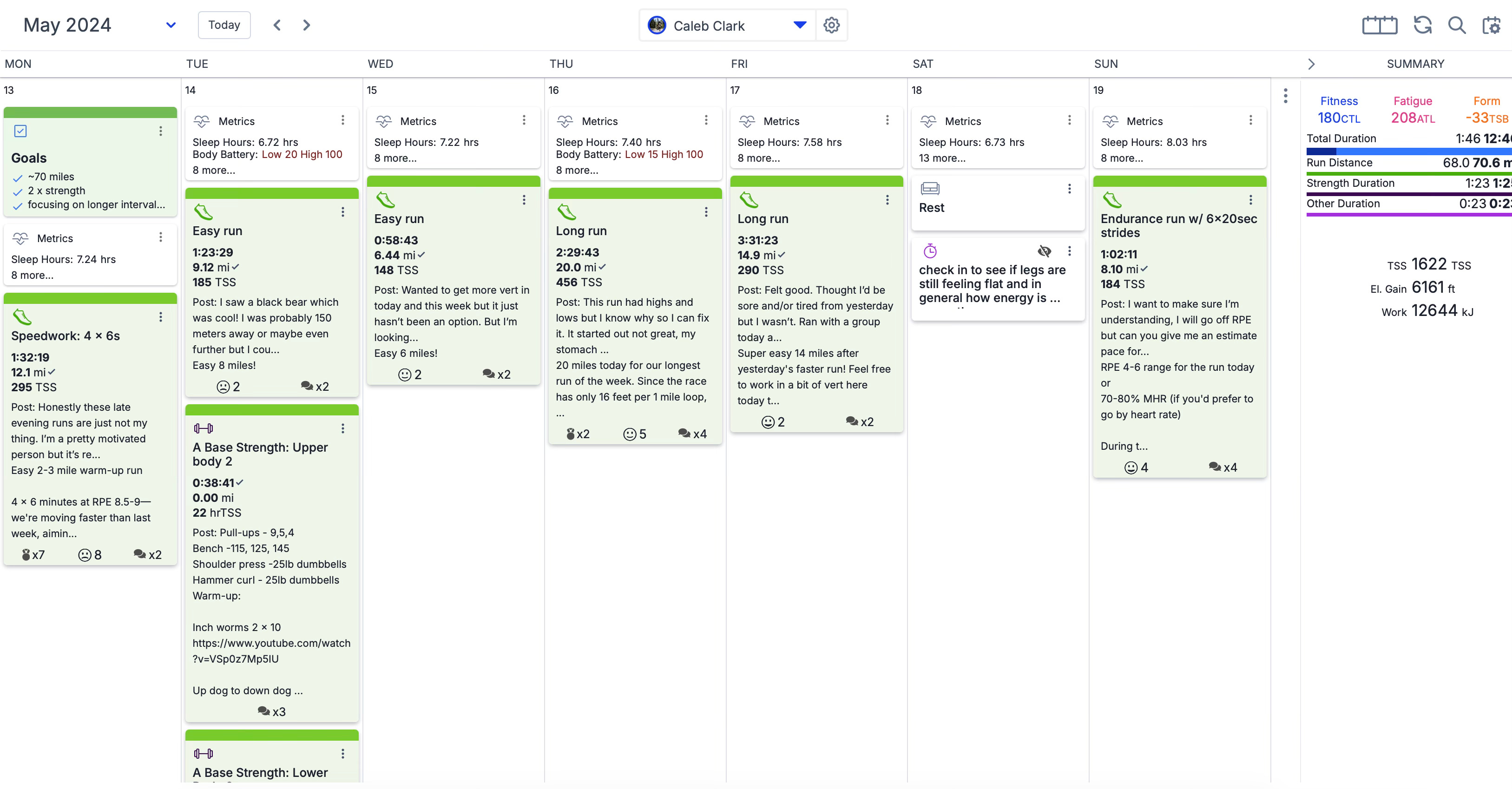
After the race, we continued building Caleb’s speed and volume. Since Caleb is both disciplined and dialed in as an athlete, we also began to introduce fun additions to his training: sauna and heat training, uphill treadmill sessions and heavier strength work. The training part of his program was successful, and we’ve tracked that growth over time through the use of time trials, often in the form of a race, and his ability to stack volume without breakdown. Here’s an example week of what his training looked like after about 18 months of working together:

Structurally, the training schedules from when we first started working together and now are similar: Caleb takes his rest days on Friday or Saturdays depending on family time. We incorporate strides, have one quality speedwork session on Tuesdays, and aim for strength sessions twice a week. However, the workouts are bigger, and on paper may look more daunting. That’s where the biggest difference lies.
As I’ve mentioned, Caleb is a gifted athlete with the ability to manage stress (in the form of both life stress and training) but he was able to identify the missing component: mental resilience. While he was able to complete his training to the best of his ability each day, we didn’t see the same approach in racing. We needed to find a way to help Caleb believe in himself, even when things got hard.
First, Caleb started to work with Nick on mental performance. They focused on Caleb’s athletic identity and untangling his self-worth from his results.
As his coach, I focused on the daily work: how could I structure Caleb’s training in a way that encouraged his resilience? And in what ways were his attachment to the outcomes of his workouts interfering with this resilience? I’d noticed that Caleb would feel like he had failed if he wasn’t able to complete his workouts to a tee—whether that was because his legs felt tired or because something happened in his life that prevented him from being able to complete it.
This isn’t specific to Caleb. Most athletes tend toward perfectionism, often because of the high expectations they set for themselves. So while this wasn’t unexpected, finding a way to encourage Caleb’s ability to complete workouts and races, regardless of whether he was having the best race of his life or having a rough time, was key.
While we could accomplish some of this with training—aiming for effort as opposed to specific paces during workouts, or focusing on consistency rather than perfection—our main focus was on the mental side.
We discussed strategies that Caleb could use when things inevitably became challenging. For example, we agreed that at some point during an upcoming race he’d start to experience doubt or anxiety. Rather than let those feelings overwhelm him in the moment, we talked about ways he could re-direct his focus to the present. Mantras, breathing exercises, and letting go of data (like avoiding looking at watch splits and metrics that could leave room for judgement) were some of the tools we decided upon.
After months of training, Tunnel Hill 100 was here. It was race day.
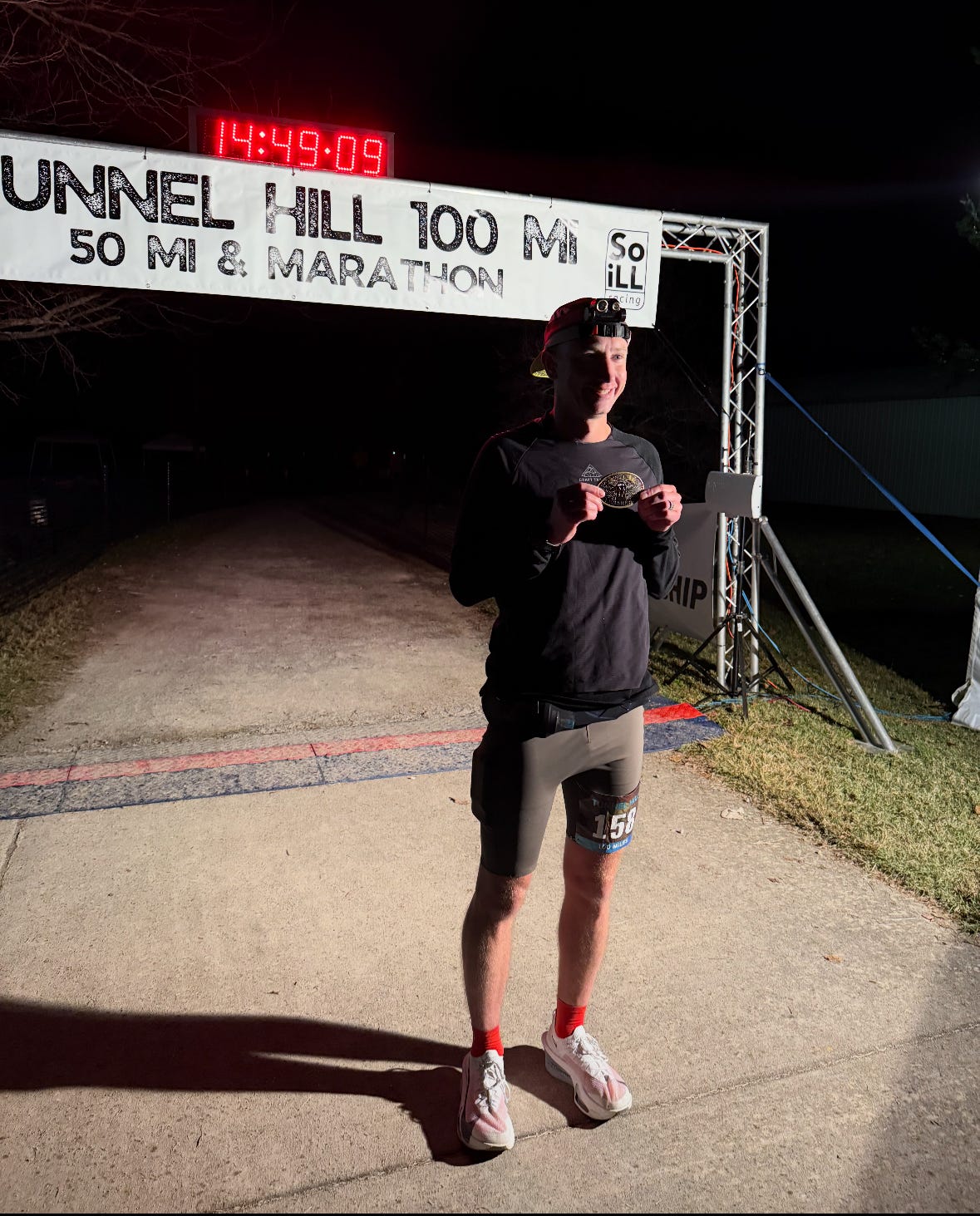
I could summarize Caleb’s race experience, but I think it’s more powerful to let him speak for himself. He graciously allowed me to share his post-race reflections:
How would you describe your overall experience during the race?
Overall I’m feeling proud of myself and also enlightened. I just didn’t have an appropriate understanding of how powerful it is to control your thoughts and focus. Staying focused directly affects running economy which directly affects the whole race.
How well did you manage mental fatigue during the race? What strategies did you use to stay focused and motivated?
I give myself an A in this department but not an A+. Compared to any other race I’ve done though I far exceeded. For most of the day I used 1 of 3 to 4 sayings/mantras. I’d say: “finish the race, everything else is bonus,” “I know you’re hurting which is ok, but it is manageable right? I mean it’s not too horrible, just uncomfortable,” “everyone else is also hurting,” “your future self would want you to keep pushing” and “you can press just a little more.”
Did you experience any decision paralysis or moments of doubt? How did you overcome them?
Moments of doubt. Honestly I didn’t overcome them, I just stopped thinking about the outcome of the race and instead focused back on my current state.
How did you handle stress before and during the race? What techniques were most effective for calming your nerves?
Box breathing before. I did box breathing the couple days leading into the race. Some during the day and before bed. Then I did it 2min before the start of the race. Also just doing my best to not think about the race when I didn’t need to. I think it’s appropriate and healthy to think about the race often especially when planning and packing, etc. but then during down times I needed to turn that off so podcasts and books are actually affective for me.
Did you encounter any unexpected stressors? How did you adapt to them?
Unfortunately, Thursday and Friday before the race were both stressful but I managed the stress so much better than in the past. Just knowing what was coming and planning ahead helped a lot. Like packing my meals for Thursday because I know flying with a toddler, it’s hard to drink and eat enough. Also just understanding that I was going to drive for 3.5 hours on Friday, do packet pickup, and then do my bottles and fill aid station crew bags with gels. I didn’t finish til 8pm. But I had no choice because I shipped my gels and drink mix to my friend who was originally supposed to meet me on Thursday but then he had to work Friday so I couldn’t see him to get my stuff til 7pm on Friday. But I just rested when I could and calmly completed tasks once I could.
What aspects of your performance are you most proud of?
Most proud of my mental state. My ability to constantly focus back on the task at hand. Really powerful experience.
What did you learn about yourself during this race?
That I’m resilient. That I actually can do this ultra thing. That may sound funny but a part of my believed that maybe this wasn’t for me since you have to be so tough to finish and I’m clearly just not tough enough to handle that pain. But I was nice to myself and told myself that it’s ok I’m hurting and it’s appropriate but that it doesn’t have to stop me.
How are you feeling now that the race is over?
I’m feeling a little in disbelief, proud, also relief that I can really do this sport I love. I’m capable of finishing. I’m capable of being tough and resilient even when it’s very painful.
As a coach, I’m incredibly proud of the work Caleb has done and I’m grateful he allowed me to share his story today!
This is such a cool case study into your approach to coaching! Your transparency is awesome & I’m grateful Caleb was willing to share this with us
A 14:46 on 60-90 mile weeks is impressive performance and that too while managing job & his family. The deeper insight into when he felt that he let himself down in his 12 hour race might have been a jolt to Caleb at that time but would have been quite a lesson which helped him after that. There is no point is throwing self serving bias stories to our own selves. It is great that both you & Nick have helped Caleb keeping his longevity in running in mind and not over reaching as our body does know from where the stress is coming- be it running, job, family and other things as well.