
JFK 50
Close competition, fast miles, and ending the year with a win

Sometime this summer, after the FKT I was eyeing was no longer a possibility, both myself and my coach, Megan, thought of JFK 50. The race itself is different than what I typically run. For one, it’s almost entirely dead-flat, save for 3,000 feet of climbing that’s primarily on the Appalachian Trail, the first section of the course. It’s also in a part of the world that I’ve spent very minimal time around. I’ve never run a race anywhere on the East Coast, let alone on the Appalachian Trail.
The race also draws deep competition, in part because it’s considered America’s oldest ultramarathon. This year was its 63rd run.
Finally, there was incentive for me as an Altra athlete since Altra was the sponsor of this year’s race.
JFK it was.
Training
Training for this race looked different than how I’ve trained for other races this year. I didn’t need to focus on vert, but volume and speed were important. Megan began incorporating track workouts into my schedule this summer and the improvements were noticeable pretty immediately. Despite non-specific training for Squamish 50K, I improved upon my own course record by nearly six minutes from the year before. During threshold workouts I was seeing paces I’d never seen before, and I felt good doing so. After World’s we decided to keep track in the rotation while also incorporating marathon-specific workouts during long runs—things like 3/2/1 miles at marathon effort and 2 miles at half marathon effort or 2 x 4 miles at marathon effort bookended by steady-state running on trails. These long run workouts were also helpful in preparing me for the transition between trail running and road running, something I’d have to be ready for when transitioning from the Appalachian Trail onto the C&O Canal Path during JFK.
I topped out at around 100 miles per week, though this was considerably less volume by hours than I had been running in preparation for World’s, simply because my vert was much lower. I continued strength training two to three times a week and biking once a week.
Preparation
I’ve raced a lot this year: a road half marathon, Chuckanut 50K, Gorge 100K, Tillamook Burn 50-mile, Broken Arrow Ascent and 23K, the local Vedder 30K, Squamish 50K, another local race up the Grouse Grind, the World’s Ascent and Short Course races and finally a local trail half marathon. With so much recent race data, I knew that I didn’t need to change my fueling or hydration plan. It had worked before and it would probably work again.
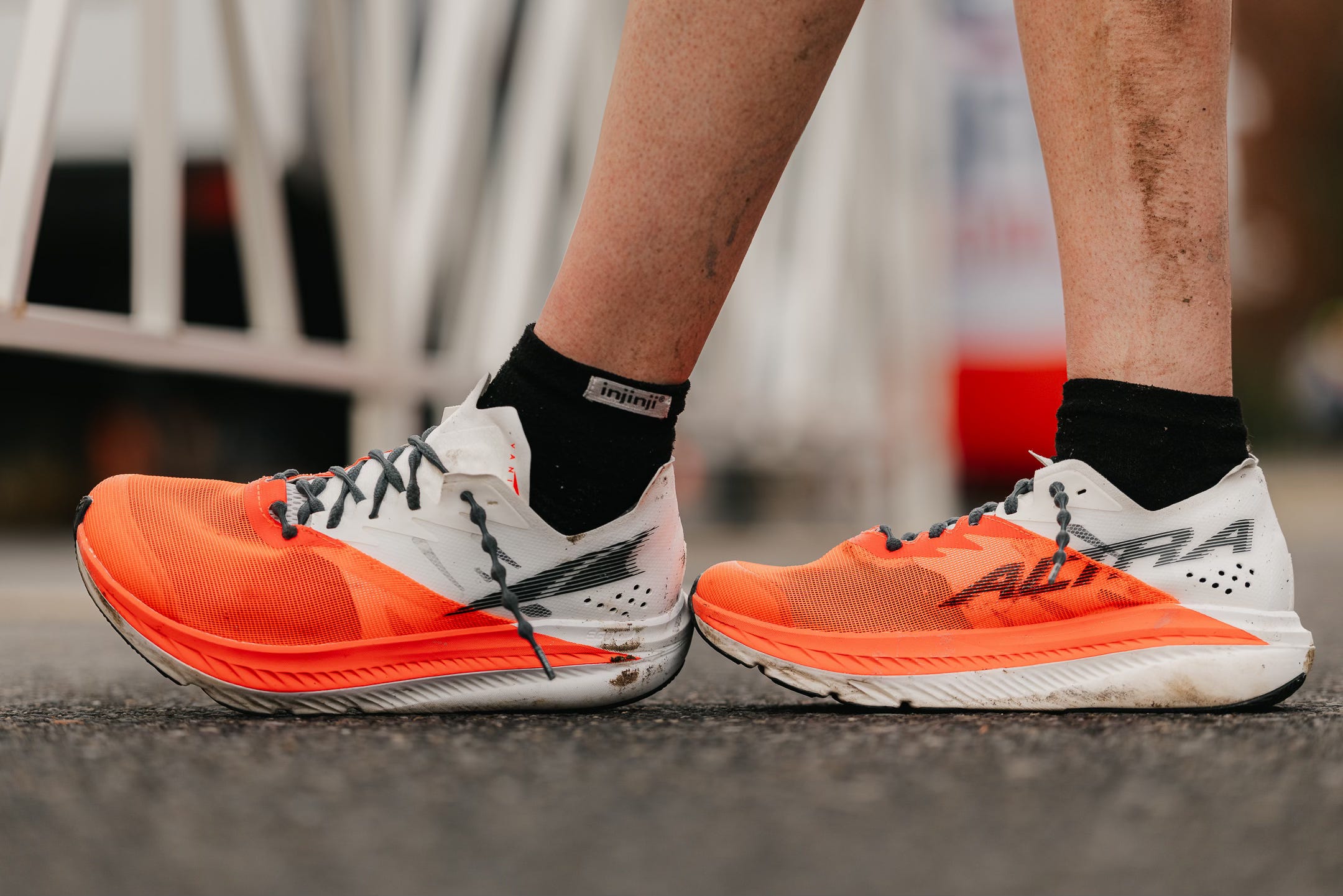
What I did need to work on, however, was the transition from trail shoes to road shoes. After wearing road super shoes for the entirety of Chuckanut 50K at the beginning of the year and wiping out many times, I knew I wanted to stick with trail shoes for the Appalachian Trail part of the race. But, I wanted a fast, light shoe for the path and road sections. I decided on the Altra Mont Blanc Carbons for the trail and the Carbon Vanish 2s for the road. In October I swapped the standard laces of both shoes for Caterpys—no-tie laces that hold tension—and began practicing the transition between shoes. During long runs I would warm-up in the Mont Blanc Carbons, then make a quick stop at the car to swap into the Carbon Vanish 2s as fast as I could. Nick helped assist me in this as he would be assisting me on race day, too.
Mental Training
I began working with a sports psychologist/neuroscientist at the end of summer and he’s introduced several new approaches to training and racing. One massive shift has been the vocalization of big goals. I tend to keep my dreams close, even to myself, but Scott suggested I make them more apparent. When he initially encouraged me to print out photos from the race and put them somewhere I could see them, I balked. I understood the benefit of visualizing the course, but this was far outside my comfort zone. Yet the more I sat with the idea, the more I wanted to give myself a shot. Why not?
So I found photos from last year’s race. To take it a step further, I even used photos of last year’s race winners—David Sinclair and Rachel Drake, two athletes I’ve never met in person. I printed them out and taped them to my wall. For the last two months, I’ve had David and Rachel staring over me as I work and considering I don’t actually know these people, it’s been as awkward as it sounds.
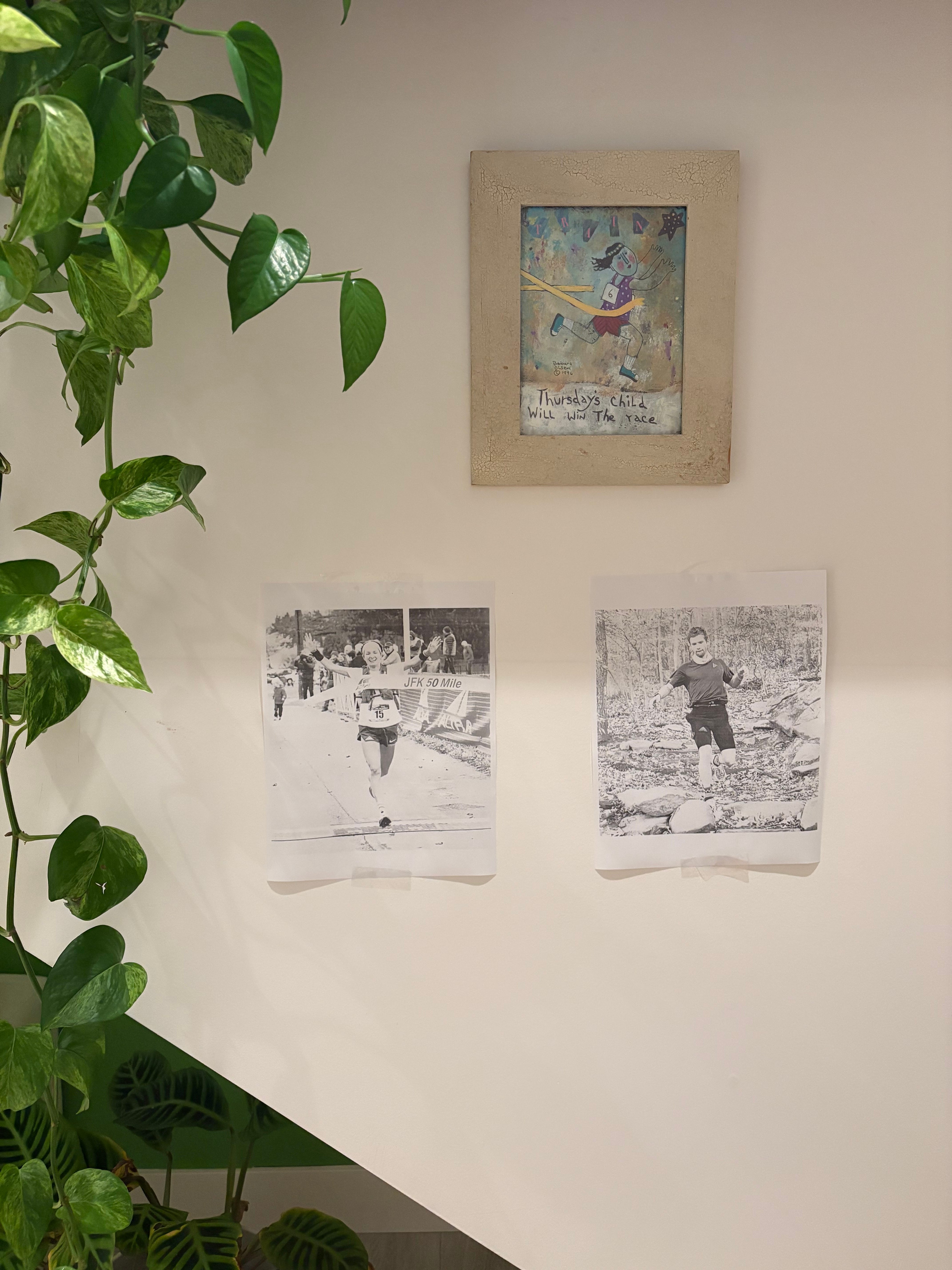
But I do think it worked. I wasn’t able to spend any time on the course before the race and yet it felt familiar. I knew what the woods would look like, the trees bare and bleak; I could envision Rachel’s pain from all those fast miles but also the elation of crossing the finish line; I could imagine being David and running nimbly over the technical trails.
Along with this visualization, I continued to develop mantras that would help me re-focus during the race. Scott also expressed the importance of showing up to the race expecting success.
Race Day
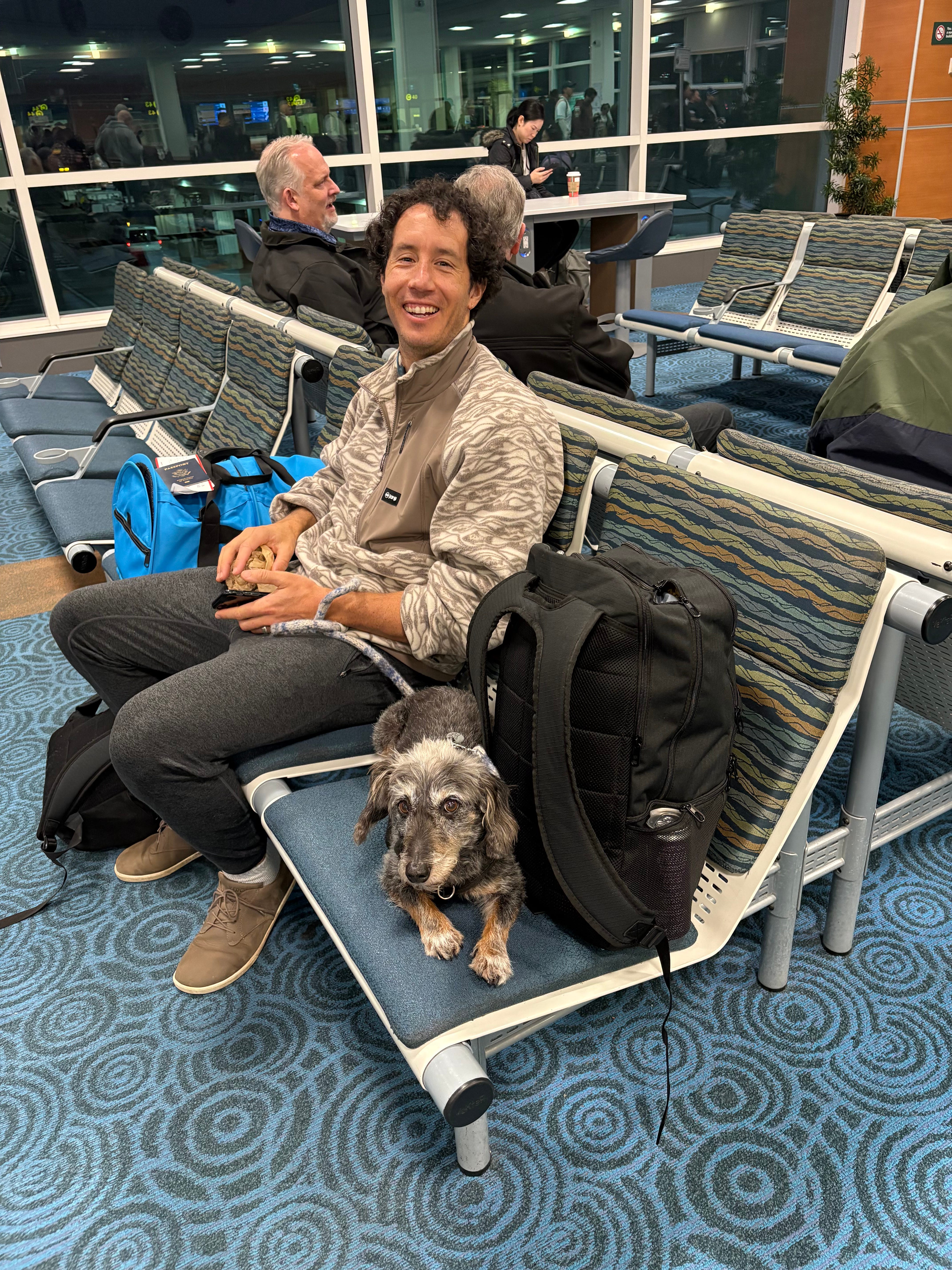
Nick and I chose to stay in Frederick, Maryland, a quaint town roughly 30 minutes from the start in Boonsboro. On race morning we woke up at 4 am, took Cashew outside, made warm drinks and drove over to the start.
The race begins in downtown Boonsboro, in the middle of the street, and it was clear this was a race with a storied past. Even in the cold dark of the morning there were locals lined up to watch 1208 runners take off into the fog.
As soon as the race started I found myself behind a large pack of men. The course travels uphill on road until the start of the Appalachian Trail. Shea Aquilano and Hannah Allgood were within seconds of me but I knew it was far too early to worry about race dynamics. I was simply focused on moving as well as I could while keeping my heart rate in check. I didn’t want to go out too fast in these early miles. As we entered the Appalachian Trail, the fog thickened and I noted that the trail was muddy. It had rained the night before, making for slippery terrain. After the race I heard that everyone expected this to be a slower year because of the trail conditions, but during the race I didn’t think about that.
Over the next few miles Shea took the lead and I lost sight of her ahead of me. Shea is a strong downhill runner so this wasn't unexpected. Occasionally I could hear Hannah’s voice behind me, but then that dissipated and it was just me with the two male runners, one ahead and one behind. I concentrated on getting in a gel every twenty minutes and taking sips of electrolyte from my handheld.
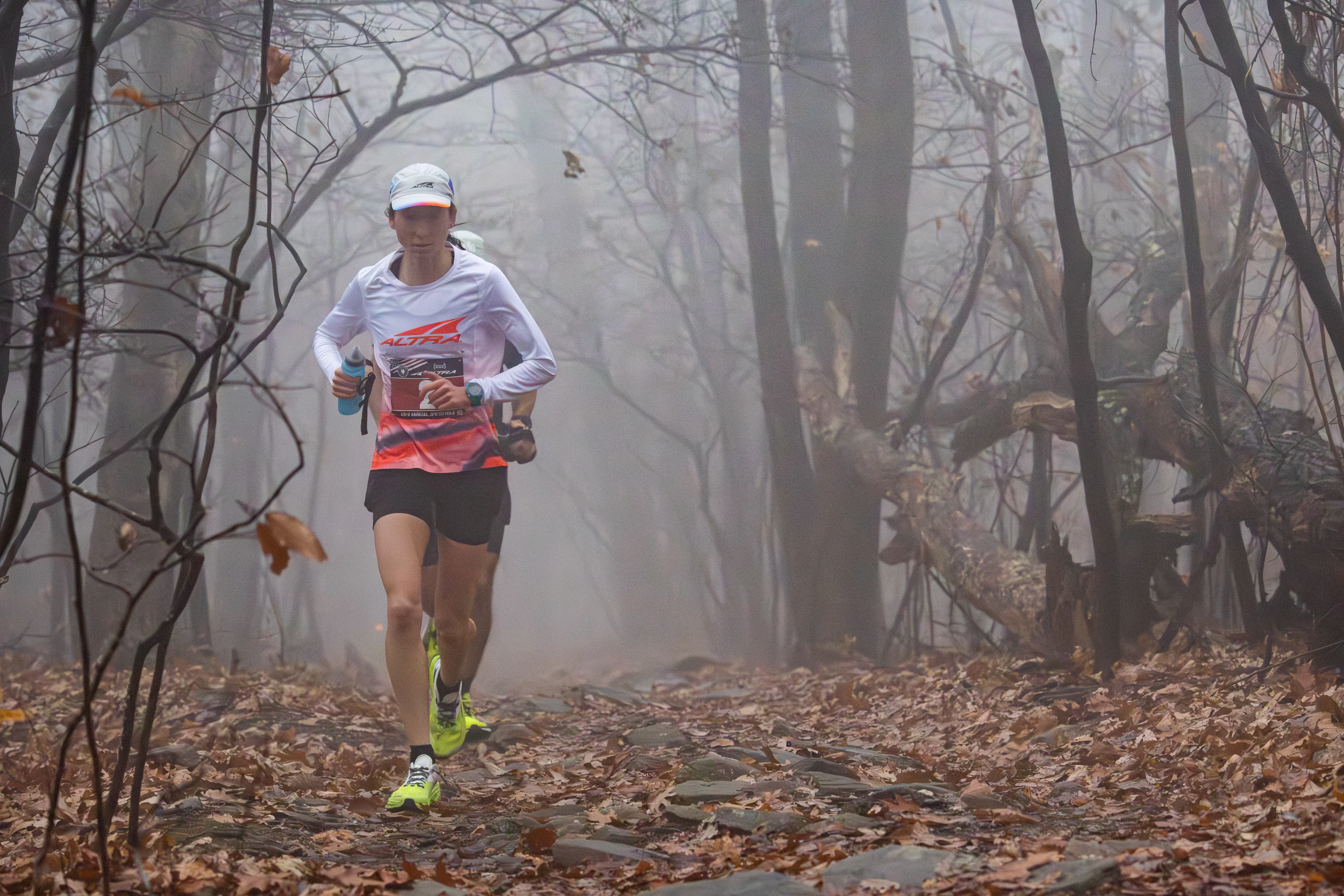
At times the trail was smooth enough to open up my stride, and at others it became rocky and chunky, reminiscent of parts of the Short Course at World’s (I wasn’t ready to be reminded of that heinous course.) I was thankful I’d only be on this until mile 14, and from then on it would be completely smooth.
After the most technical section of the course down the Cliffs, I popped out onto the road and into the first crew-accessible aid station. Now it was time to see if the shoe transition practice had paid off.
Switching from my trail shoes to my road shoes with the help of Nick. Cashew looks on approvingly.
The shoe transition was quick, and I stopped only briefly to tighten the laces a half mile out of the aid station. Then I was focused on making up time on the C&O Canal Path.
As soon as I popped out onto the path, two things occurred: one, I picked up a biker in orange who, as it turns out, would follow me for the rest of the race, capturing my every move and two, I caught sight of Shea. I was maybe a minute back, but I determined that I was moving faster than her because I was quickly closing on her. By mile 16 I had nearly caught her but decided to bide my time because I really needed to use the bathroom.
I pulled off into the bushes (which ended up being more like briars—I have scratches across my face and arms to prove it.) A minute later I was back on the path, the biker re-starting his camera and following me once more. Shea had regained a solid lead ahead of me again but I wasn’t concerned. I was confident I could close it over the next few miles.
During this minute stop, Hannah caught up to me. We briefly chatted and then I noticed her increasing the pace. She put in a few surges but each time I matched her effort. I was hurting, but it sounded like she was breathing harder than me.
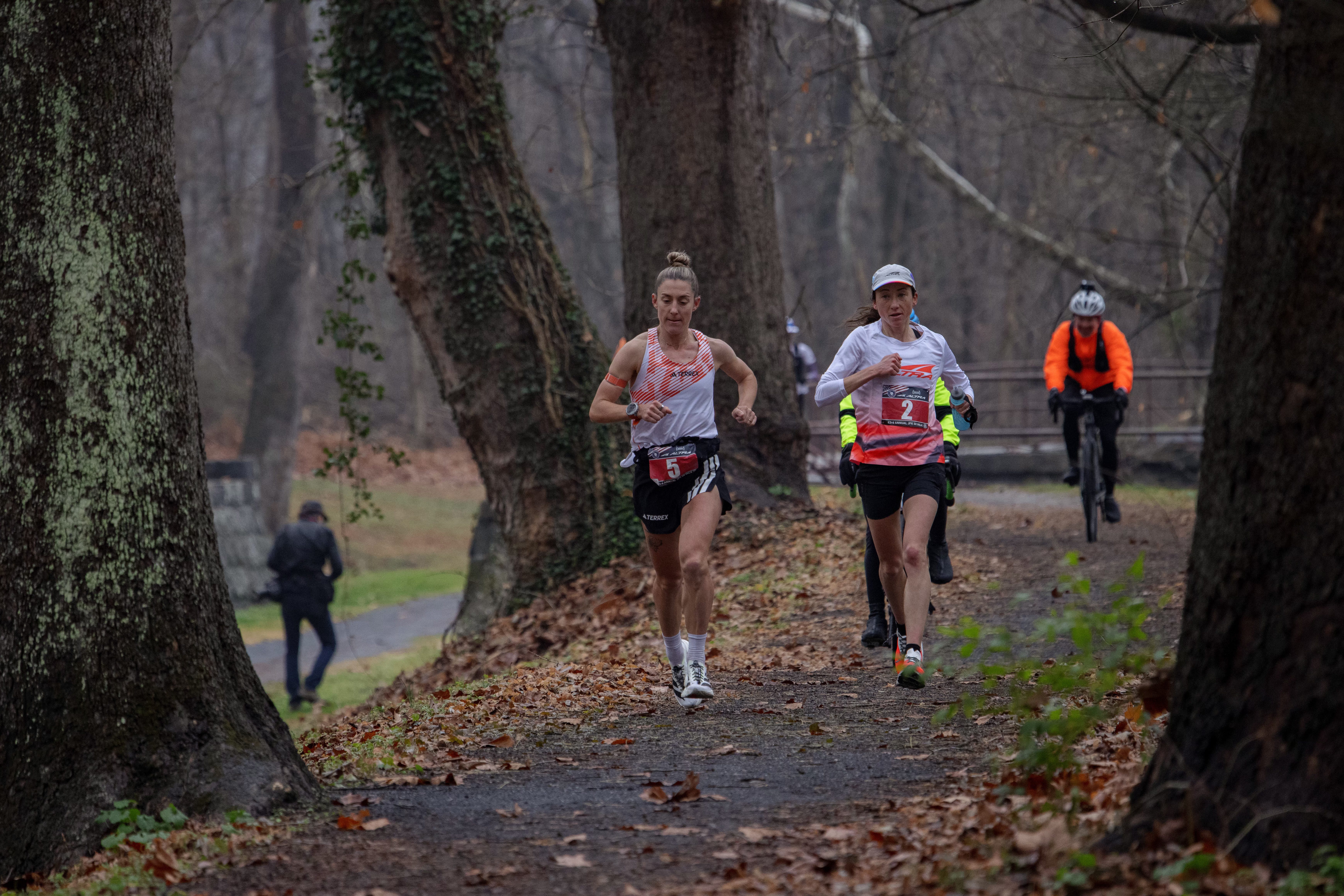
Together we caught Shea and from then on it was the three of us within 10 to 20 seconds of each other until the end of the canal path. I found myself mostly in the lead, though every few miles Shea would catch up to me and try to surge, I’d match her pace or get ahead, and then the cycle would repeat.
My stomach was a little off during the race, which isn’t typical for me. After 70+ trail races, mostly ultramarathons, I’ve never thrown up but for the first time I was puking in my mouth as I ran. I decided to lay off the caffeinated gels and dial back calories until my stomach settled. I reasoned it was simply the effort; I’d never run this far, this fast. I was PRing my 50K time in the middle of the race, running 3:34.
At the final crew-accessible aid station, I finally passed Shea for the last time. Once I exited the canal path and turned onto the road, I decided to use my climbing strength to try and put a gap on Shea. I had noticed during the Appalachian Trail section that I would quickly catch up to Shea and put space between myself and Hannah during the climbs, so I wanted to use that to my advantage.
I’ll admit that these hills were far bigger than I had anticipated. Sure, there were some downhill sections where I could drop into 6:30 min/mile pace but I was otherwise trying to run climbs with legs that felt like sludge. I tried to keep my gaze focused on the lead biker ahead of me. Just behind me, two orange bikers chatted. They kindly asked if I minded their banter, to which I replied that it was absolutely fine and it was. I was hurting too much to care.
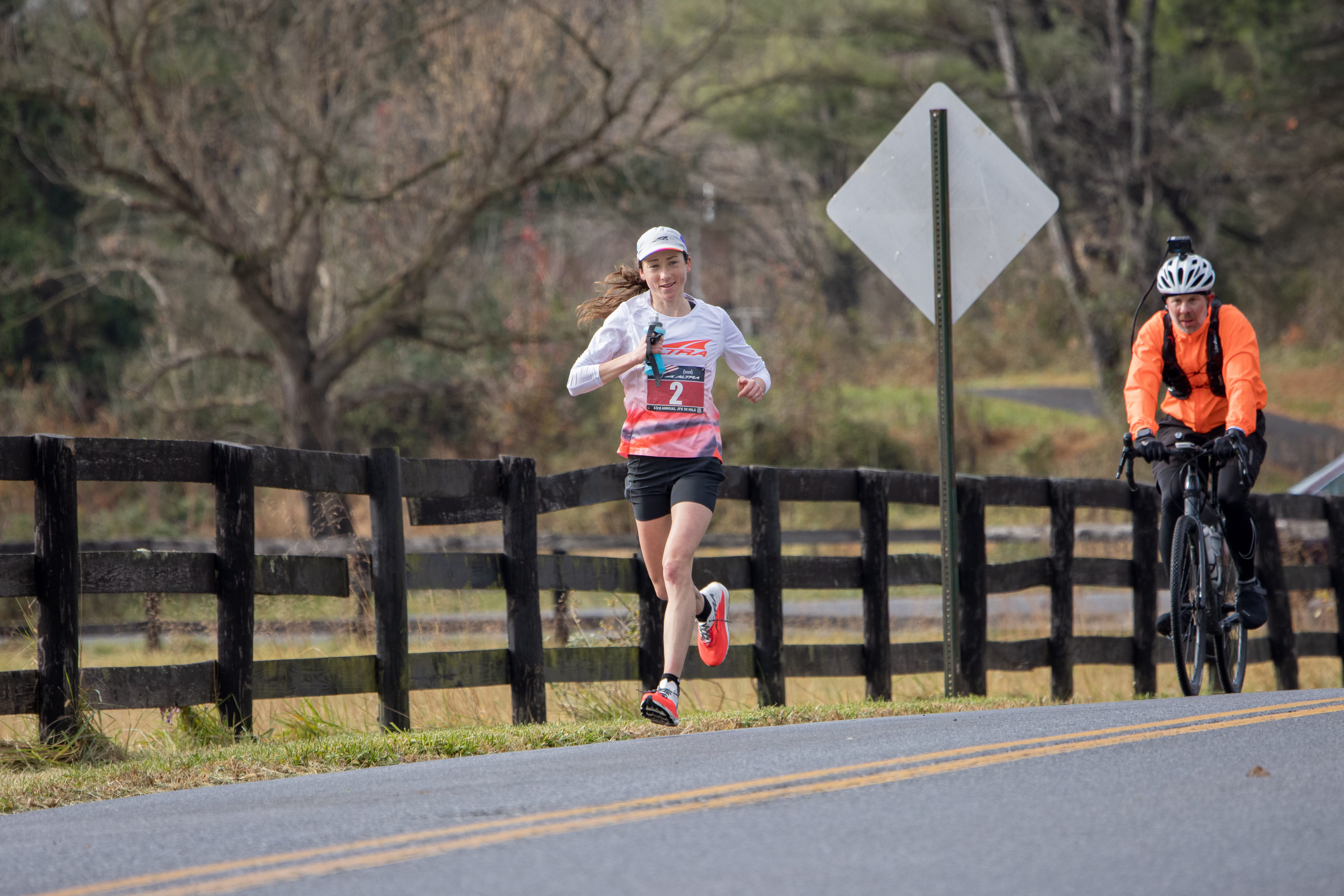
I usually refrain from getting excited about winning until I’ve actually won—that is, until I’ve crossed the finish line and it’s guaranteed, no surprise sprint that catches me off guard. But this was my day to lean into what Scott and Megan have been pushing me toward: believing in myself. So I believed that I was going to win. I just needed to finish the race and get it done.
The final mile runs past a highway exit and along a gas station that curves (uphill!) to the finish. I was close! I was so exhausted that I had to set a goal for myself in the final 400m of the race. Just get to that stop sign. Okay, now focus on making it to the yellow cone. All right, now it’s across the finish line and you’re done!
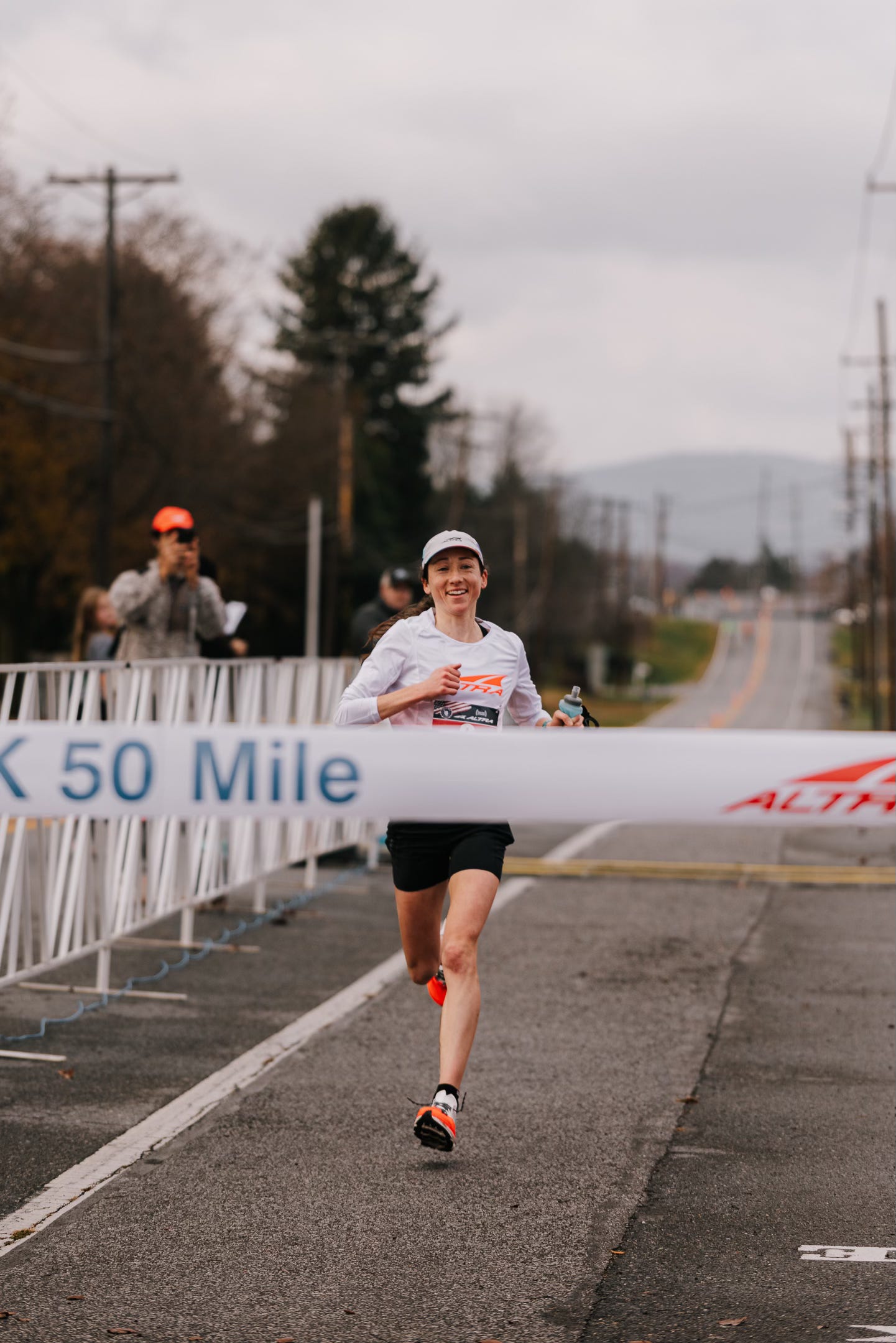
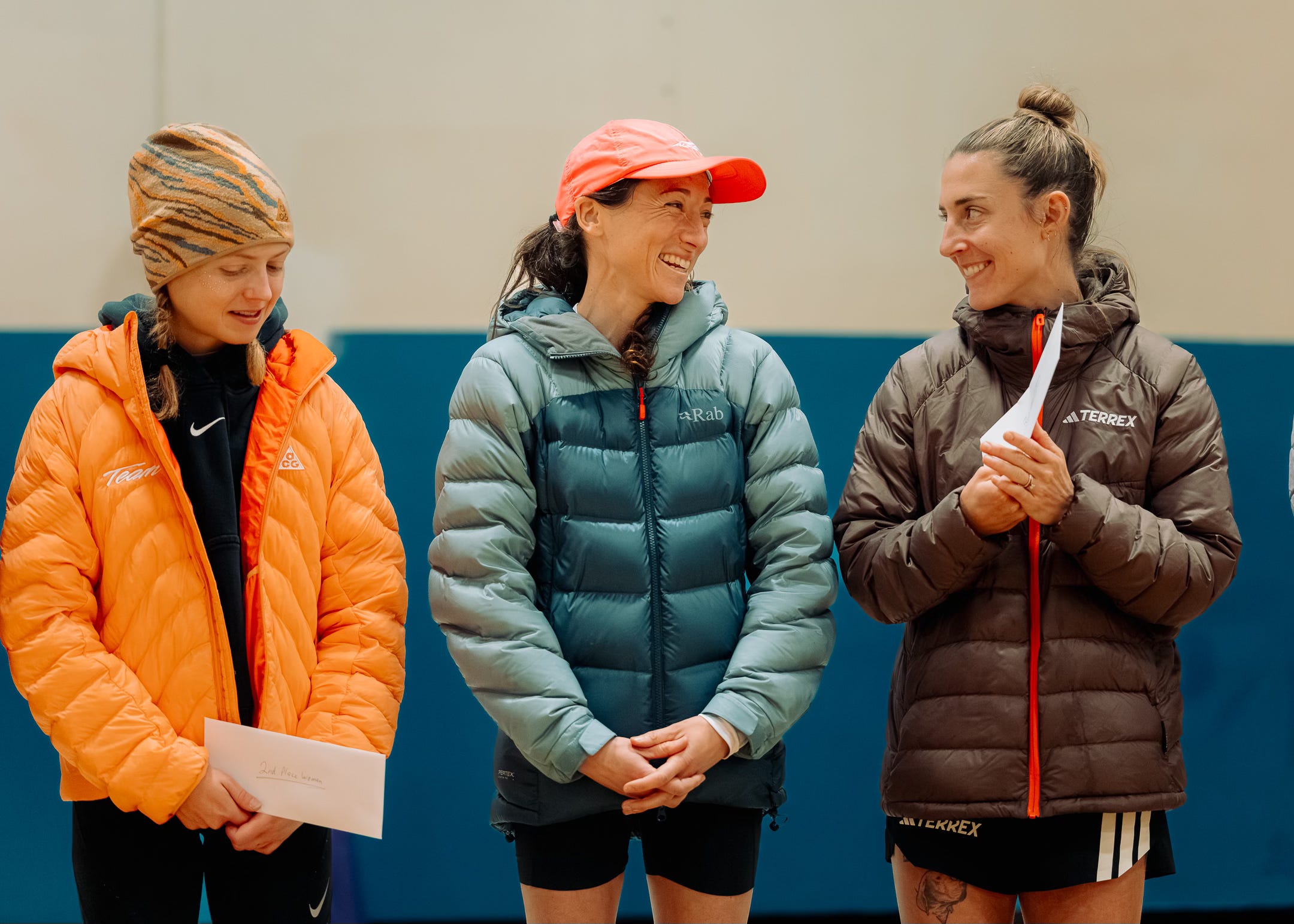
I crossed the finish line in 6:07:53. I had just enough time to hug Nick and fist bump Altra teammate Hans Troyer who had won the men’s race before watching Shea Aquilano come in second place, only two minutes behind me.
Takeaways
Every ultra that I run feels like the accumulation of all that I’ve run before, so in this way I’m building on prior lessons. And so much of it comes down to problem solving in the moment. An upset stomach is solved by backing off your intake for a few minutes or foregoing the caffeinated gels; a competitor attempting to pass is met with a quickened pace because you’ve done the workouts and know you can hit those paces; fear about being caught is let go and instead replaced with quiet confidence that you can outrun them. Each time I race, whether I meet my goals or not, I’m learning for the next one.
It’s been a big year of racing for me, and one that I feel immensely grateful for. I was healthy all year and had the opportunity to race 13(!) times. Thanks to the magic of my coach, Megan, I’m ending the year faster than when I started, too.
There have been several people who have supported me in my dreams this year including Megan, Scott, and Altra’s fantastic team manager, Colby Gould. My dad is not a runner himself but he knows more about every race that I run than I do, and he’s the first person I call after I finish.
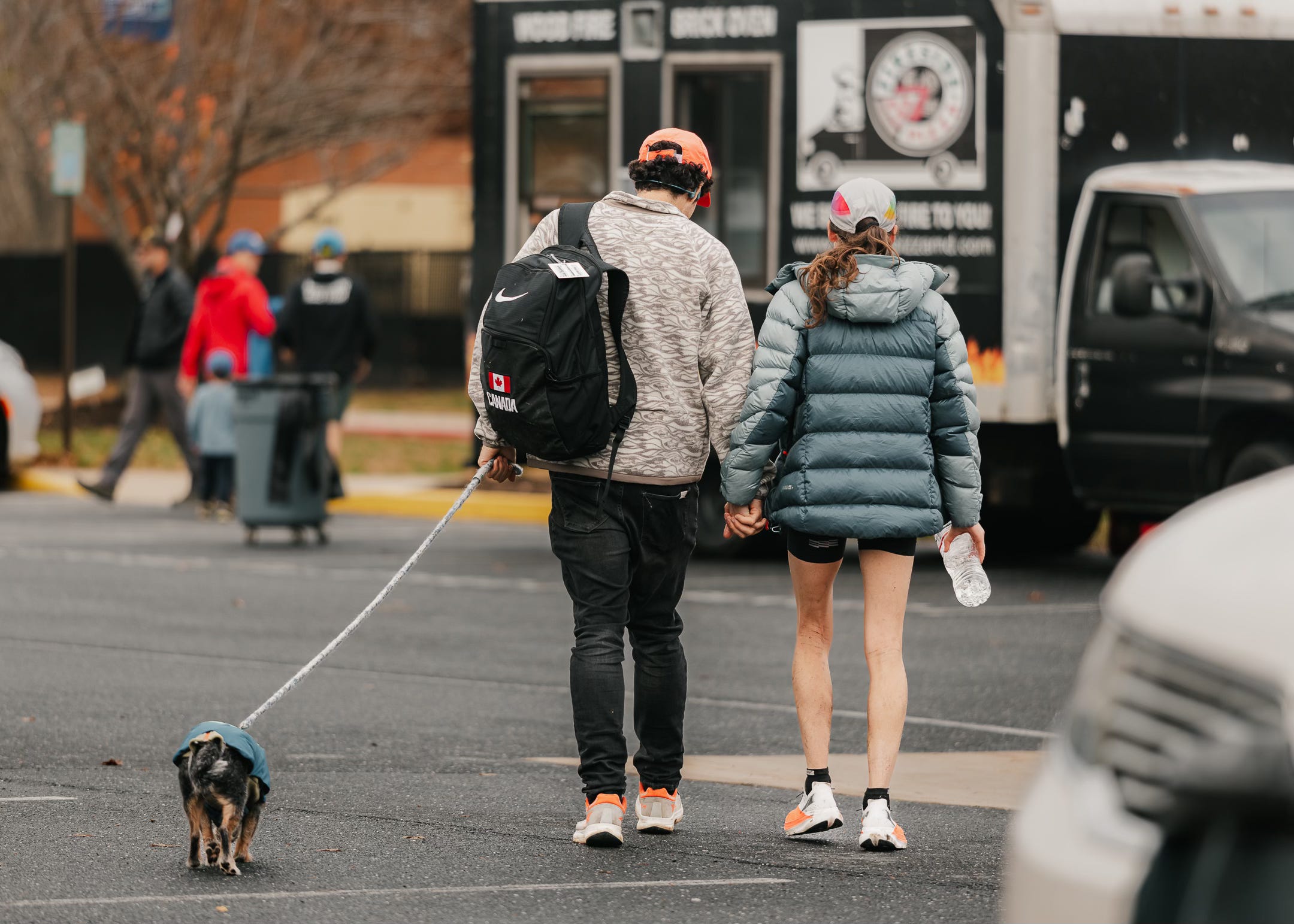
Most importantly, I’m thankful for Nick. We function as daily training partners, even though our running goals are different, and he’s there to crew and support me at every single one of my races. Cashew is also there, though his services only include post-race licks.
So what’s next? You’ll be the first to know when I do. Maybe.
What I can tell you is that I’ll be taking all of the lessons learned in my 2025 races right into 2026.
Thanks for reading!
Jade of the year!!!
Such a wonderful recap! So excited for you to rest, soak in the success, and see what’s next. Thanks for sharing your journey with us- it inspires me a great great deal.